


Beneath the plain, unassuming exterior of a mass-produced automotive radiator lies a masterpiece of multi-disciplinary engineering, designed to balance three mutually exclusive, often conflicting priorities: maximum possible heat transfer efficiency, minimal overall weight to improve vehicle fuel economy, and 10+ years of reliable, leak-free operation under the harshest possible real-world driving conditions.
Nearly every new passenger vehicle rolling off global assembly lines today uses an all-aluminum radiator construction, built around two core structural elements: thin flattened horizontal tubes that carry hot coolant across the full width of the unit, and thousands of delicate serpentine cooling fins bonded tightly between every pair of adjacent tubes. These fins are not randomly shaped or placed: automotive thermal engineers use advanced computational fluid dynamics software to simulate thousands of different fin curve patterns, louver spacing values, and metal thickness measurements, ensuring that passing air is thoroughly mixed to break up the stagnant cool air layer that would otherwise stick to metal surfaces and act as an insulating barrier that drastically reduces heat transfer.
The two end tanks mounted on either side of the aluminum core, usually made from heat-resistant glass-fiber-reinforced nylon, are injection-molded with intricate internal baffles that distribute incoming hot coolant evenly across every single tube, preventing flow dead zones that would leave large sections of the radiator completely unused and reduce total cooling performance by as much as 25%.
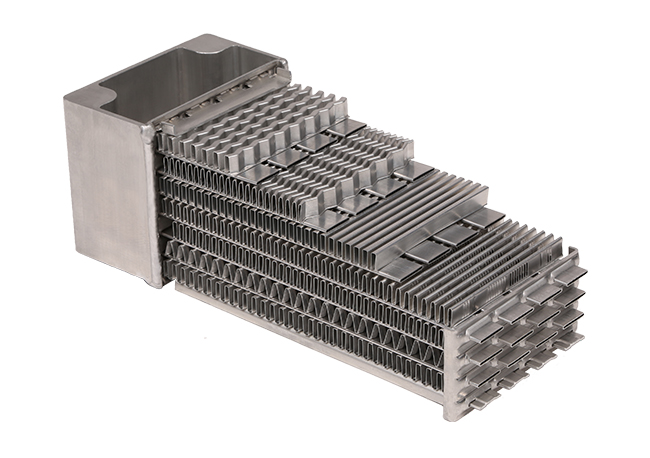
The modern industrial manufacturing process for these radiators is a marvel of automated precision. Precisely cut aluminum tubes and fins are stacked together in a custom high-tolerance fixture, then run through a 600-degree Celsius vacuum brazing oven in a single continuous pass, where the surface of the aluminum melts slightly under controlled atmospheric conditions to form a seamless, leak-proof joint between every fin and tube, eliminating the weak lead-based soldered connections that were the most common failure point in older copper radiators.
Every single finished radiator then goes through a rigorous multi-stage quality testing process: first, units are pressurized to twice their maximum rated operating limit and fully submerged in deionized water to detect even the tiniest micro-leaks that would be completely invisible to the human eye. Next, they are mounted on a computer-controlled vibration test rig that replicates the constant high-frequency shaking of driving over rough gravel roads for 200 consecutive hours, to ensure no internal joints crack under sustained long-term mechanical stress.
Finally, they are subjected to 10,000 rapid thermal cycles, swinging from -40 degrees Celsius to 130 degrees Celsius in less than 10 minutes, to simulate decades of seasonal temperature changes without developing metal fatigue cracks that would eventually lead to leaks.
Even the seemingly trivial detail of tube wall thickness is carefully calculated down to a tenth of a millimeter: engineers reduce it to the absolute minimum that can withstand long-term internal pressure, cutting down the distance heat has to travel from the hot coolant to the flowing outside air, while adding just enough structural strength to resist gradual corrosion from acidic degraded coolant.
The end result is a 6-kilogram production radiator that can reliably dissipate more than 25 kilowatts of waste heat, an engineering achievement that would have been completely impossible with the heavy, inefficient copper radiators produced just 50 years ago.
Post time: Jul-16-2026