


Our state-of-the-art high-performance tube mill production line stands as a pinnacle of modern manufacturing engineering, seamlessly integrating a comprehensive suite of cutting-edge processes to deliver consistently stable, ultra-high-quality tube manufacturing solutions tailored specifically for the most demanding industrial and automotive heat-exchanger applications. Engineered with precision and durability at its core, this production line is not merely a manufacturing system but a strategic asset for businesses seeking to meet and exceed the rigorous performance standards of today’s heat transfer technology, where reliability, efficiency, and dimensional accuracy are non-negotiable.
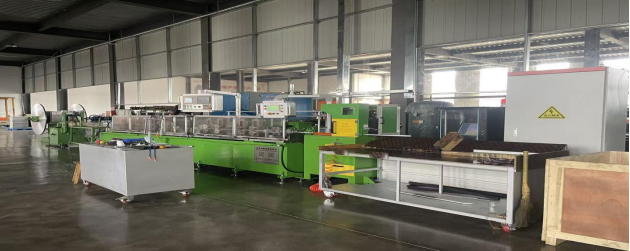
The production journey commences with a robust dual uncoiling and strip feeding system, a foundational design element that eliminates production interruptions and ensures an uninterrupted, stable flow of raw metal strip material. This dual-uncoiler configuration enables automatic switchover between material coils without halting production, a critical feature for maintaining continuous operational efficiency and minimizing downtime. By delivering a consistent, tension-controlled feed of the metal strip, this initial stage sets the stage for flawless downstream processing, preventing material misalignment, warping, or inconsistencies that could compromise the integrity of the final tube product. This stability in material supply is paramount for achieving uniform tube wall thickness, consistent profile shaping, and overall production reliability.
Following the precision feeding stage, the metal strip advances to the precision roll forming molds, where advanced tooling and computer-controlled forming technology shape the flat strip into a perfectly uniform seamless open tube profile. These custom-engineered molds are crafted from high-grade alloy materials to withstand continuous high-speed operation, ensuring that every inch of the strip is formed with meticulous accuracy, maintaining consistent cross-sectional dimensions and smooth surface finish. Once the open tube profile is formed, the process advances to its technological core: high-frequency welding, powered exclusively by American Thermatool high-frequency welders—the undisputed global leader in high-frequency welding technology, renowned for setting industry benchmarks in weld quality, efficiency, and reliability.
At the heart of this production line lies the original imported Thermatool CFI solid-state high-frequency welder, a technological masterpiece that elevates welding performance to unprecedented levels. This advanced welding system boasts exceptional anti-interference capability, ensuring stable operation even in the most demanding industrial environments with high electrical noise. Its precise frequency tracking technology automatically adjusts welding parameters in real time to match the material properties and line speed, guaranteeing optimal heating conditions at all times. The ultra-fast heating speed of the Thermatool welder enables rapid, efficient fusion of the tube edges, while its superior energy efficiency reduces operational costs and environmental impact—key advantages for sustainable modern manufacturing.
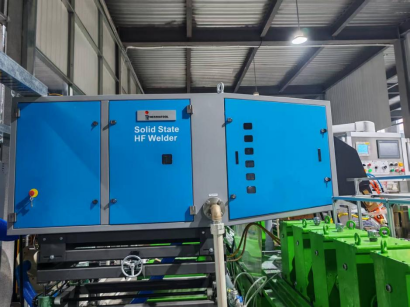
The Thermatool CFI welder delivers uniformly distributed heating across the weld zone, resulting in exceptionally smooth, aesthetically pleasing welds with full, robust, and metallurgically sound weld seams. This precise heating eliminates common welding defects such as incomplete welding, missing welds, porosity, or cracking, ensuring the weld seam possesses the same strength and durability as the base metal itself. This level of weld integrity is critical for heat-exchanger tubes, which must withstand continuous thermal cycling, pressure fluctuations, and corrosive operating conditions without failure.
Post-welding, the newly formed tube undergoes a controlled water cooling process to stabilize the weld and base material, followed by thorough air drying to prepare the tube for further precision processing. The tube then enters a series of precision sizing dies, where dimensional refinement takes place to achieve exacting outer diameter, inner diameter, and roundness specifications. These precision dies are calibrated to micron-level tolerances, ensuring the tube meets the strict dimensional requirements of heat-exchanger applications.
Post time: Apr-27-2026