


The brazing procedure executed in this dedicated industrial brazing furnace stands as the most critical, high-precision core step in the entire radiator manufacturing workflow, directly defining the structural integrity, sealing performance, pressure resistance and overall service lifespan of finished heat exchangers. In the automotive, construction machinery, and industrial cooling sectors, radiators operate under extreme and fluctuating conditions—sustaining high thermal stress, continuous vibration, coolant pressure, and long‑term cyclic fatigue.
Brazing quality is therefore not merely a production detail but a fundamental determinant of whether a radiator can meet strict OEM performance requirements, ensure operational safety, and maintain stable cooling efficiency over years of heavy use. Without a tightly controlled, high‑precision brazing process, even the most precisely designed radiator cores cannot achieve reliable metallurgical bonding, leading to early failures such as coolant leakage, fin detachment, tube rupture, and insufficient heat dissipation.
Pre-Brazing Preparation & Flux Application
All connecting joint surfaces are evenly coated with specialized aluminum brazing flux via precise spraying or immersion application. The flux is formulated to remove micro‑oxides, improve melt flow, and promote strong fusion between aluminum components without corrosion or residue.
Once prepped, the cores are systematically loaded onto the automated conveyor line and fed into the professional continuous brazing furnace, ensuring consistent positioning and stable throughput for mass production.
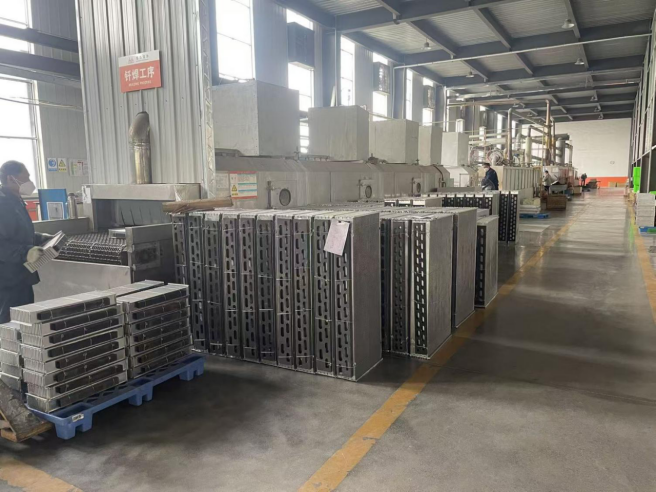
Dual-Zone Furnace Temperature Design
This furnace features a dual-zone temperature design, perfectly segmented into a front drying section and a rear high-temperature brazing working section. This zoning ensures that heat application follows a scientific curve, preventing thermal shock and ensuring flux activation before brazing.
Clean indirect heating driven by natural gas combustion. Eliminates residual surface moisture, evaporates volatile contaminants, and activates brazing flux. Uniform airflow distribution ensures consistent treatment across every part of the workpiece.
Optimal range for aluminum alloy brazing. High‑efficiency heating elements with closed‑loop control maintain stability within ±2°C, ensuring uniform heating across large or complex radiator structures.
Continuous Nitrogen Inert Gas Protection
During the entire staged heating process, continuous nitrogen inert gas protection is injected into the sealed furnace chamber, effectively preventing high-temperature oxidation of aluminum alloy materials. Oxidation would otherwise form a dense barrier that prevents metallurgical fusion, leading to leakage and structural failure.
The nitrogen atmosphere maintains a clean, non-reactive environment that preserves the brightness and performance of the base material.
Metallurgical Bonding & Joint Formation
Under this precisely controlled thermal and atmospheric environment, the brazing flux melts and distributes uniformly across all contact interfaces, forming a permanent, leak-free metallurgical bond between fins, tubes, headers and other core components. Unlike mechanical joining or gluing, brazing creates a unified atomic structure that delivers exceptional strength and durability.
The molten filler metal flows smoothly into gaps through capillary action, solidifying into a dense, pressure‑resistant joint.
High-Precision Brazing Performance Benefits
As the heart of radiator production, this advanced brazing technology ensures every unit achieves top-tier cooling efficiency, reliable durability and global-standard quality performance for heavy-duty truck, commercial vehicle, construction machinery and industrial cooling system applications.
By upholding extreme precision in temperature, atmosphere, flux application, and conveying speed, the brazing furnace transforms assembled components into robust, long‑lasting heat exchangers that meet the world’s most demanding industrial standards. In an industry where safety and reliability are non‑negotiable, this brazing process is truly the foundation of quality radiator manufacturing.
Post time: Apr-27-2026