


As the global automotive industry undergoes its fastest technological shift in a century, moving rapidly away from fossil-fuel-powered internal combustion engines toward battery electric and plug-in hybrid vehicles, the automotive radiator is not becoming obsolete — it is evolving into a far more complex, multi-functional component that solves entirely new thermal management challenges that never existed for traditional gasoline cars.
Unlike a conventional vehicle that only needs to remove waste heat from its engine, a modern electric car requires three completely separate, precisely calibrated cooling systems:
- 1. Battery Pack: one to keep the high-voltage lithium-ion battery pack locked within its strict 25 to 40 degree Celsius optimal temperature window.
- 2. Drive System: a second to dissipate heat from the high-revving electric motor and silicon carbide power inverter.
- 3. Cabin Control: a third dedicated circuit for the cabin climate control system.
All three of these independent thermal loops route their excess heat to a network of compact, purpose-built radiators mounted at the front of the vehicle, which must operate efficiently both in -20 degree Celsius winter conditions and on 45 degree Celsius summer days, while never wasting unnecessary energy that would reduce the vehicle’s total real-world driving range.
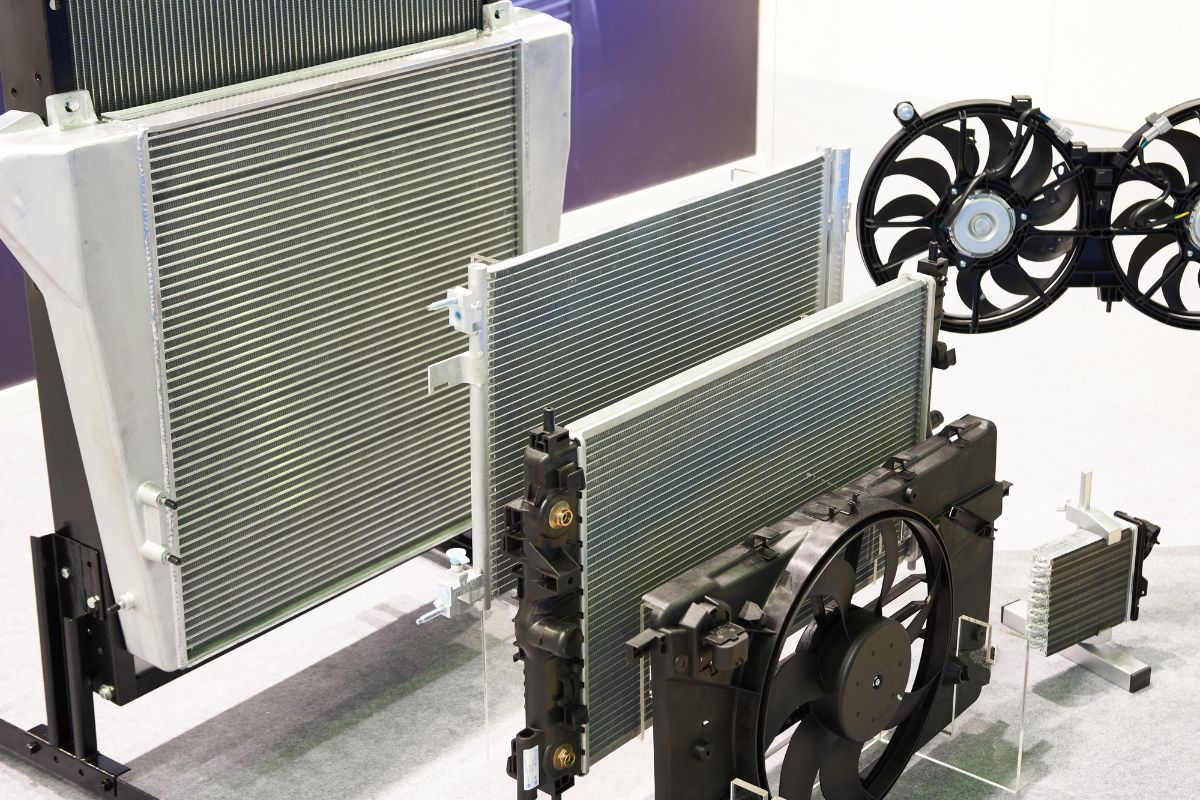
This new generation of EV radiators operates at far lower peak heat loads than their ICE counterparts, which has allowed thermal engineers to design much thinner, more aerodynamic core assemblies that reduce front-end aerodynamic drag by more than 15%, directly adding dozens of kilometers of extra range to every full battery charge. Many latest electric vehicles use a dual independent radiator layout, where two separate small cooling cores can be selectively shut off with motorized aerodynamic shutters when their cooling capacity is not needed, eliminating unnecessary airflow resistance during high-speed highway cruising.
In cold winter weather, these advanced radiators can be almost completely bypassed, allowing waste heat from the electric motor and power electronics to quickly warm up the battery pack to its ideal operating temperature, drastically improving DC fast charging speed and low-temperature energy efficiency.
The most cutting-edge current innovations even integrate radiator cooling surfaces directly into the vehicle’s front bumper structure, eliminating the need for a bulky separate mounting frame and freeing up valuable under-hood space that can be used to expand the size of the front trunk or accommodate extra battery modules to extend range further.
While the very first automotive radiators were invented 130 years ago to solve the basic problem of cooling burning gasoline, today’s electric vehicle radiators are the unsung key to overcoming one of the biggest limitations of modern EV technology: preserving battery performance, fast charging capability, and long-term lifespan across wildly different global climate conditions.
Far from being a legacy leftover from the era of internal combustion, the radiator is evolving right alongside the zero-emission automotive revolution, proving that even the oldest, most familiar under-hood components still have a central, irreplaceable role to play in the sustainable future of global transportation.
Post time: Jul-16-2026